Follow me on 🔗Linkedin, 🐙GitHub
“If computers could talk, they’d either demand faster processors or more pizza.” –
Hey there, fellow tech-enthusiast! Today, let’s dive into the magical world of Text to Speech (TTS). Whether you want your AI assistant to talk back like JARVIS from Iron Man, or create an audiobook version of your latest blog post, TTS will come to your rescue.
Find the code repository here
Table of Contents
- Make your Text Speak
- Use Cases for Text to speech
- Various Models and their strengths
- Make AI Speak in your Voice
- Future of Speech to text and beyond
1. Make Your Text Speak 🗣️
Imagine typing a line of text, and boom — your computer actually reads it out loud! No more tedious reading; let your AI handle it.
What is TTS?
TTS (Text To Speech) is a technology that converts written text into spoken voice output. For example, you can feed a sentence like:
“Hello, world. I am an AI and I love coffee!”
…and it’ll produce a delightful audio clip saying that exact sentence.
Here are a few simple python codes to make your Text to Speech application
Note that you will need to have python>=3.8 installed
Python Example 1
Below is a simple (and popular) Python library called pyttsx3 that runs offline (no internet connection needed)
Install this library first by doing
pip install pyttsx3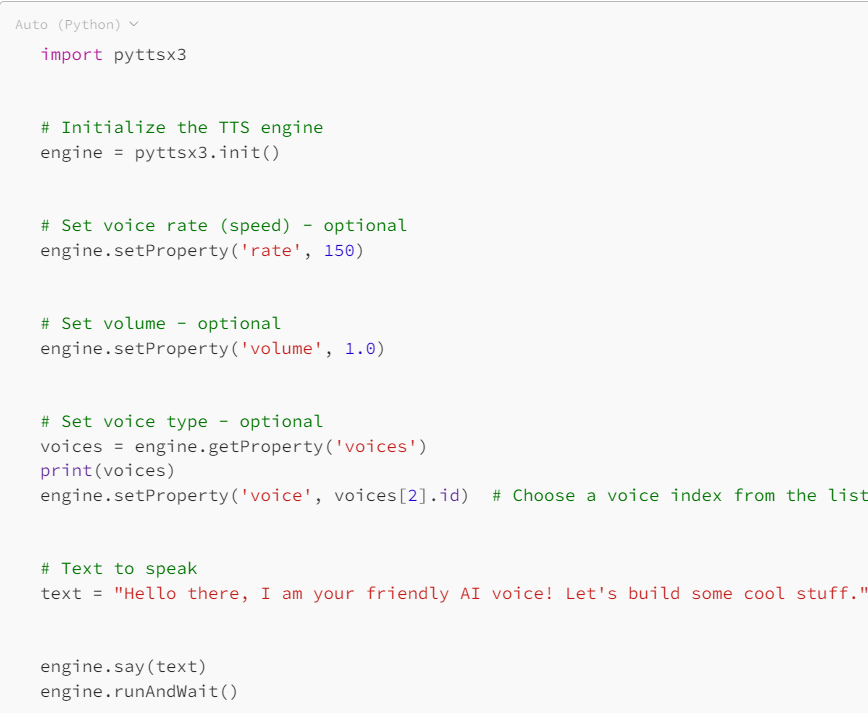

PLAY — Output.wav
- Voice Rate: Increase or decrease rate to make the speech faster or slower.
- Voice Type: You can choose from the available voices on your machine. Check with voices = engine.getProperty(‘voices’).
- Volume: Range between 0.0 (mute) to 1.0 (full volume).
Python Example 2
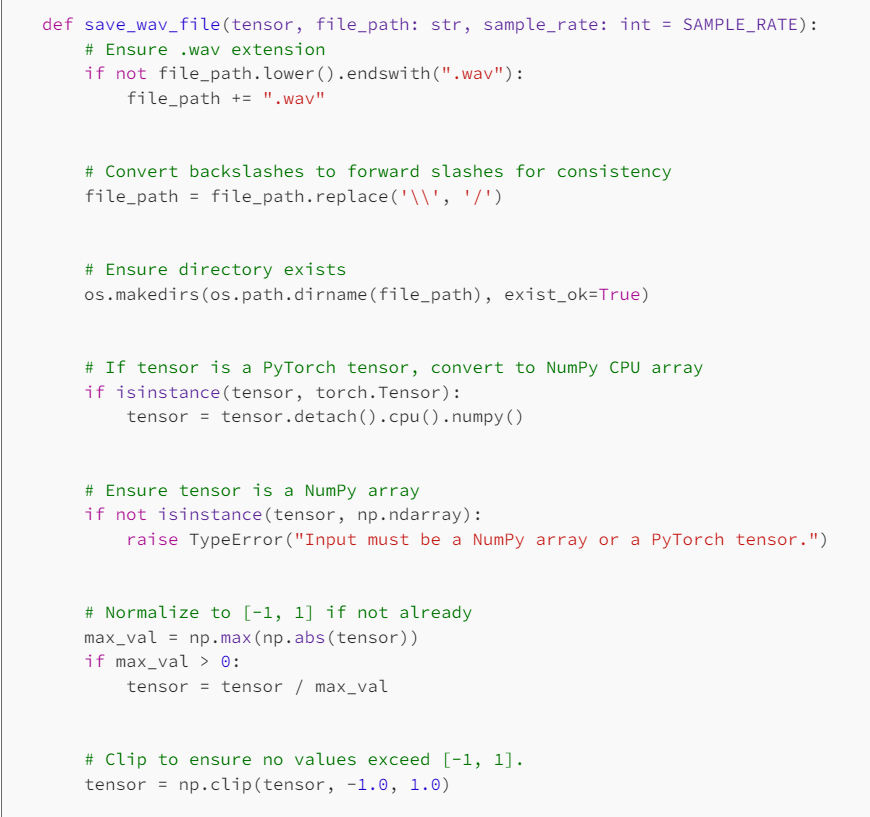
Here is an advanced python library called bark-tts. Bark-TTs is created, managed and open sourced by suno-ai. Bark runs completely local and uses advance Ai techniques like neural networks to generate voice samples from provided text input.
Here is an example of how you can use this using python.
Note that you will need a GPU to run it locally
Install bark like
pip install git+https://github.com/suno-ai/bark.git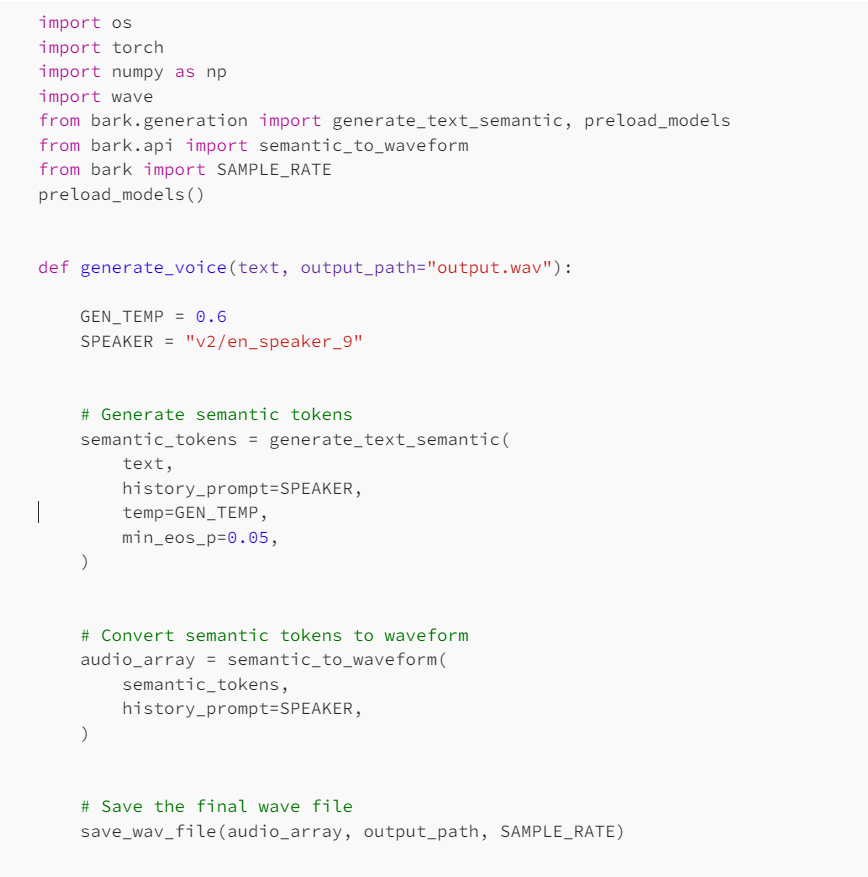
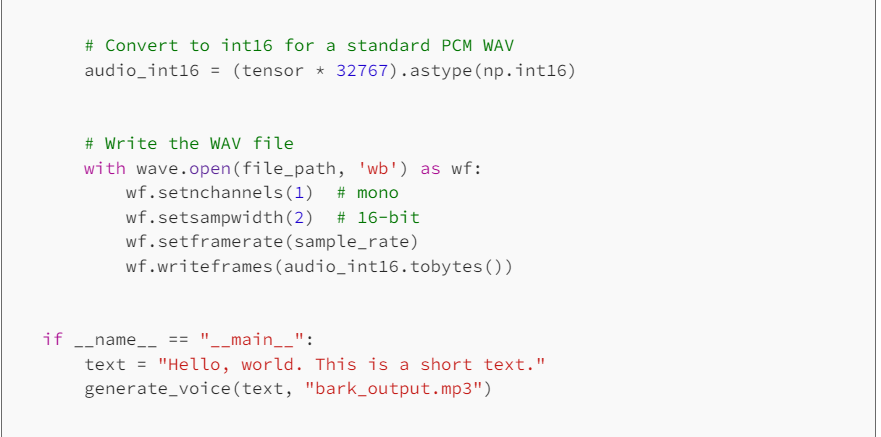
It doesn’t end here, bark goes way beyond that it also has included multiple sound-phrases showing its advanced capabilities . You can include the following sound phrases to your text input and get the voice generated
- [laughter]
- [laughs]
- [sighs]
- [music]
- [gasps]
- [clears throat]
- — or … for hesitations
- ♪ for song lyrics
Use them in your code like below
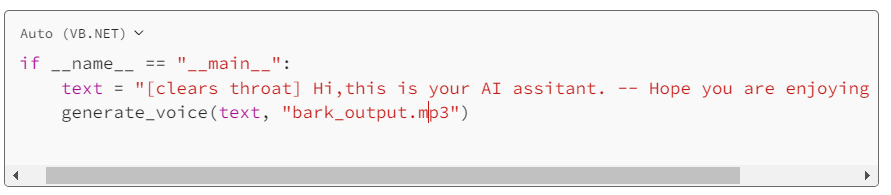
PLAY — bark_output_with_sound_phrases.wav
2. Use Cases for Text to Speech 🚀
Text to Speech isn’t just about making your computer talk for fun. It has a wide range of real-world applications:
- Audio Books — Convert lengthy documents or books into audio for easy listening.
- Accessibility — Help visually impaired users or those with reading disabilities.
- Voice Assistants — Power your personal or business AI chatbots with a human-like voice.
- Customer Support — Automated phone systems (IVR) can provide quick voice responses.
- Language Learning — Hear the pronunciation of words in different languages.
“Words have power, and when you make them speak… well, that’s next-level power!” –
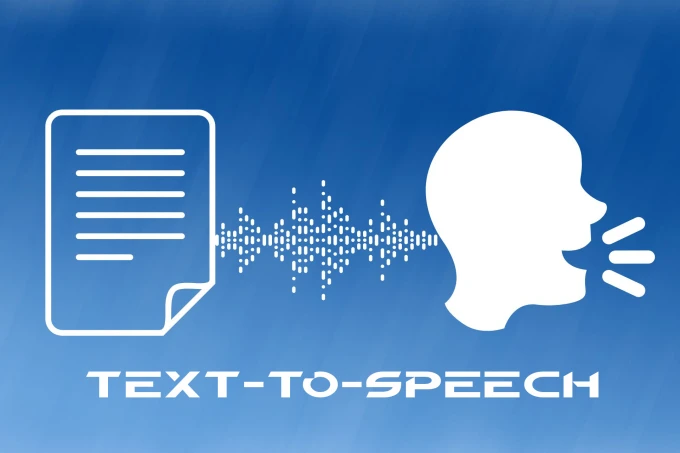
3. Various Models and Their Strengths 🤖
Over the years, plenty of TTS models have popped up, each with their own benefits. Let’s look at some heavy hitters and the cloud providers that offer them:
Different cloud services for TTS
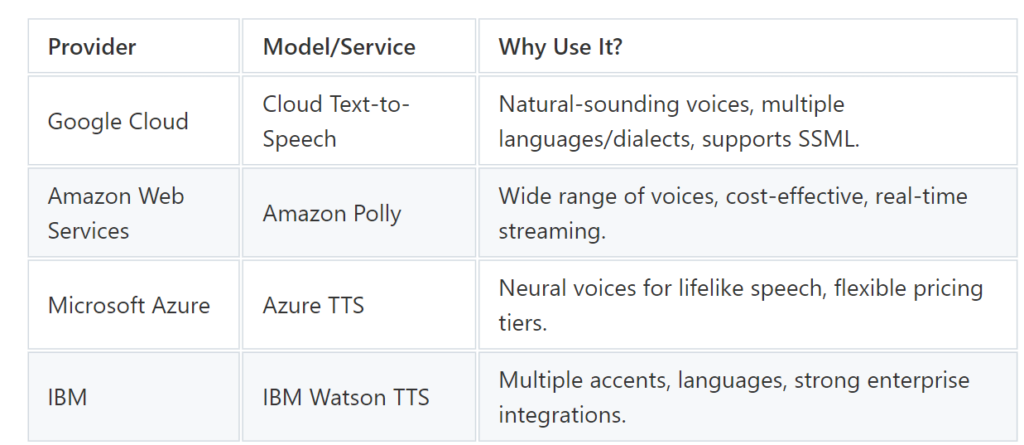
Strengths and Benefits 💪
- Naturalness: Neural or Deep Learning models now produce voices that are hard to distinguish from humans.
- Multilingual Support: Many cloud services support dozens of languages, perfect for a global user base.
- Scalability: Cloud platforms easily handle large volumes of TTS requests.
- Customization: SSML (Speech Synthesis Markup Language) helps you tweak pitch, speaking rate, and more.
4. Make AI speak in your voice..🚀
So far we have been making the AI speak in the default trained voices, ever wondered if we could make it speak in our own voice?
Well that’s quite possible using voice cloning.
Voice cloning is the process of replicating a person’s voice using artificial intelligence (AI) and machine learning (ML) techniques. This technology enables the creation of synthetic voices that sound nearly identical to the original speaker, maintaining their tone, pitch, accent, and speech patterns.
How Voice Cloning Works
- Data Collection — The process begins with collecting audio recordings of the target speaker. The more high-quality data available, the better the cloned voice will be.
- Preprocessing — Background noise is removed, and the voice data is cleaned and segmented to ensure clear and accurate model training.
- Model Training — Deep learning models, such as generative adversarial networks (GANs) or text-to-speech (TTS) systems, are trained on the speaker’s voice data to capture their unique characteristics.
- Deployment & Use Cases — The cloned voice can be used in applications such as voice assistants, dubbing, customer service automation, or even restoring voices for people who have lost their ability to speak.
Applications of Voice Cloning
- Entertainment & Media — Used for voiceovers, dubbing in movies, and animated characters.
- Accessibility — Helps people with speech impairments regain their voice through AI-powered speech synthesis.
- Customer Support — AI-powered chatbots and virtual assistants can communicate with a natural and familiar voice.
- Gaming & Virtual Worlds — AI-generated voices for characters in video games, VR environments, and storytelling applications.
- Personalized Content — Enables customized audio messages in marketing, education, and social media.
Concerns & Ethical Considerations
- Misinformation & Deepfakes — Malicious use of voice cloning can lead to deepfake scams, impersonation, and fraud.
- Privacy Risks — Unauthorized cloning of someone’s voice without consent raises legal and ethical concerns.
- Regulation & Security — Companies are implementing watermarking techniques and ethical guidelines to prevent misuse.
Key Players in Voice Cloning
Companies such as ElevenLabs, Resemble AI, iSpeech, and OpenAI are advancing the field by offering voice synthesis tools that allow users to create realistic and customizable voices.
5. Future of Speech to Text & Beyond 🚀
Wait, speech to text? Yes, it’s the sibling technology to text to speech — converting spoken words back into written text. The future is bright (and loud!) for speech-related AI:
- Video Generation & Lip Sync: Models that not only produce voice but also generate matching facial movements. Imagine a virtual newscaster reading your blog with perfect lip sync!
- Deepfake Audio & Video: Tools that can clone voices and generate realistic footage. A double-edged sword, but with huge potential for entertainment and content creation.
- Language Translation on the Fly: Real-time speech translation, bridging communication gaps worldwide.
- Multi-Modal Experiences: Combine speech with gesture recognition, face recognition, or AR for immersive experiences.
“Coming soon: AI that not only speaks your text but also performs your text with full body gestures.” –
Final Thoughts 🤔
Text To Speech has evolved from robotic monotones to near-human performances. It’s a crucial tool in modern AI applications — from accessibility to entertainment, from learning aids to real-time translation. The possibilities are endless!
Enjoy Building! 🎉
I hope this blog has put you on a path to make your text speak. Now, go unleash that creative beast and build something awesome!
“Remember, the only limit is your imagination (and maybe your CPU)!”
More Resources
Happy coding & Talking ! If you have any questions or suggestions, feel free to reach out or leave a comment.
Leave a Comment