Follow me on 🔗Linkedin, 🐙GitHub
This is a work done by me in collaboration with Aihello
Introduction
Imagine you’re having a conversation with a friend, but instead of a person, it’s an AI like ChatGPT, DeepSeek, or Gemini responding to you.
These AI models can chat, write, and even help with tasks like answering emails or summarizing news. But how do they do it? Let’s break it down in the simplest way possible.
How Do AI Models Learn to Talk?
Think of AI like a student learning a new language. Instead of teachers, it learns from massive amounts of text — books, articles, websites, and conversations. These AI models don’t understand language the way humans do, but they recognize patterns.
Here’s an easy way to think about it:
- Reading Lots of Text — The AI “reads” billions of sentences from different sources.
- Finding Patterns — It notices which words often appear together and how sentences are structured.
- Predicting the Next Word — Just like when you type on your phone, and it suggests the next word, AI predicts words to form logical sentences.
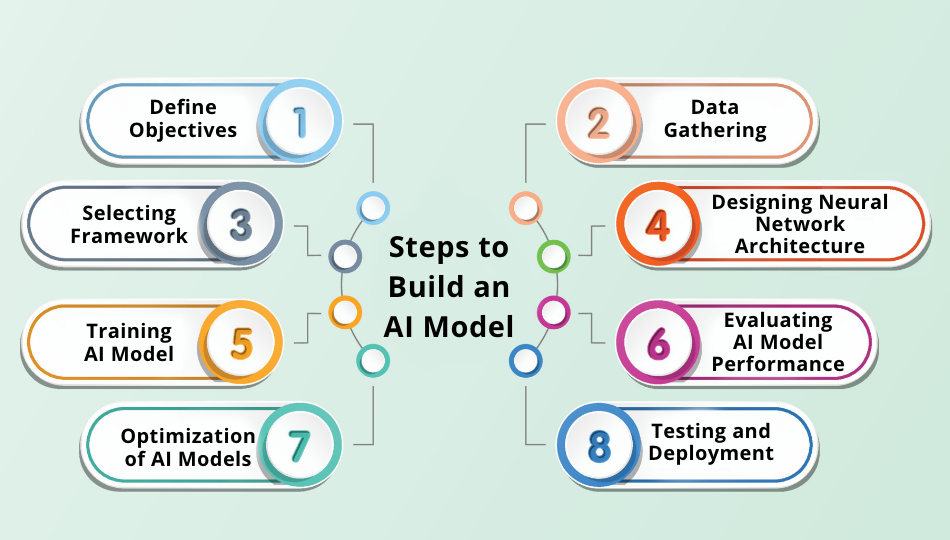
This process of reading and finding patterns is called “training,” and it’s done using huge amounts of data and powerful computers. Whereas predicting the next word to generate an answer is called “inferencing”.
This training is done using advanced methods such as Machine-Learning or Artificial Neural Networks which are the basis for AI models. Inference is just testing the generated AI-model using a set of inputs or tasks.
How Does AI Generate Responses?
When you ask a question, the AI doesn’t actually think like a human. Instead, it follows these steps:
- Understand Your Words — It breaks down what you’re asking, finding key words and context.
- Search for Patterns — It looks at all the text it has learned from and finds similar conversations.
- Predict a Response — Based on what it has seen before, it chooses the most likely response.
When we say it chooses the most likely response it is actually choosing one word at a time and predicting the next word based on the previous words.
For example, if you ask:
“What’s the best way to make pancakes?”
The AI doesn’t cook pancakes, but it has read thousands of recipes and articles. It puts together a response by predicting the most useful answer based on what people usually say about pancakes.
It starts looking at the words that were put together from the thousands of recipes that it had read earlier and starts predicting one word at a time to finally develop a complete response.
Why Do AI Responses Feel So Real?
AI models like ChatGPT, DeepSeek, and Gemini are trained on so much data that they can mimic human writing styles, jokes, emotions, and even different tones. They don’t feel emotions, but they can predict words in a way that sounds natural.
Imagine a parrot that repeats words it has heard many times. Now imagine a super-smart parrot that doesn’t just repeat words but understands the patterns of conversation. That’s how AI generates text!

Where Do We Use AI Text Generation?
AI is everywhere, even if you don’t realize it. Here are some common uses:
- Chatbots & Virtual Assistants — When you chat with customer service bots.
- Writing Emails & Content — Helping businesses create blog posts, emails, and reports.
- Language Translation — Converting text from one language to another.
- Educational Tools — Helping students learn by explaining concepts in simple terms.
What Are the Challenges?
Even though AI is impressive, it’s not perfect. Some of its challenges include:
- Making Mistakes — Sometimes, AI gives incorrect or misleading answers.
- Bias in Answers — If the AI was trained on biased information, its responses might also be biased.
- Over-Reliance — People might start depending too much on AI without verifying information.
- Hallucinations — Creating content that is wrong, doesn’t make sense, or doesn’t match the information given, basically inventing information.
- Limited Information — Ai heavily relies on the input information referred to as `training data` and hence it might not have latest information like news or information about events that happened beyond the ‘cut-off date’.
The “cut-off date” for an AI refers to the last point in time when its knowledge was updated. After this date, the AI doesn’t know about any new events or developments. This helps you understand what the AI can and can’t answer.
That’s why experts constantly improve AI models to make them more accurate, fair and up to date.
Note:- Many advanced LLM projects like ChatGPT and Perplexity have introduced internet-powered LLMs. That is they have connected the AI to the internet.
This does not mean that they are ‘trained’ on that information but they only have access to it so that they can search the internet on the fly to look for similar information or events that the user is talking about.
What’s Next for AI?
In the future, AI might become even better at:
- Understanding emotions and responding in a more human-like way.
- Combining text, images, and videos to create richer content.
- Following ethical rules to prevent misinformation.
Conclusion
AI models like ChatGPT, DeepSeek, and Gemini don’t actually “think” like humans, but they are great at recognizing patterns in language and predicting the best responses. By learning from huge amounts of text, they can generate human-like conversations, making life easier in many ways.
So next time you chat with an AI, remember — it’s not magic, just a really smart pattern-recognition system!
Happy reading! If you have any questions or suggestions, feel free to reach out or leave a comment.

Leave a Comment