With the rise of Knowledge Graphs, driven by Generative AI’s ability to autonomously construct and leverage them for structured storage and retrieval, understanding traditional graph-based models becomes essential.
Key approaches like Graph Neural Networks (GNNs), GraphSAGE, and Temporal Graph Networks (TGNs) each offer unique methods for processing graph-structured data. Exploring their differences and underlying mechanisms is crucial for effectively working with Knowledge Graphs; and this is what we will be exploring in this article.
Graph Neural Networks (GNNs)
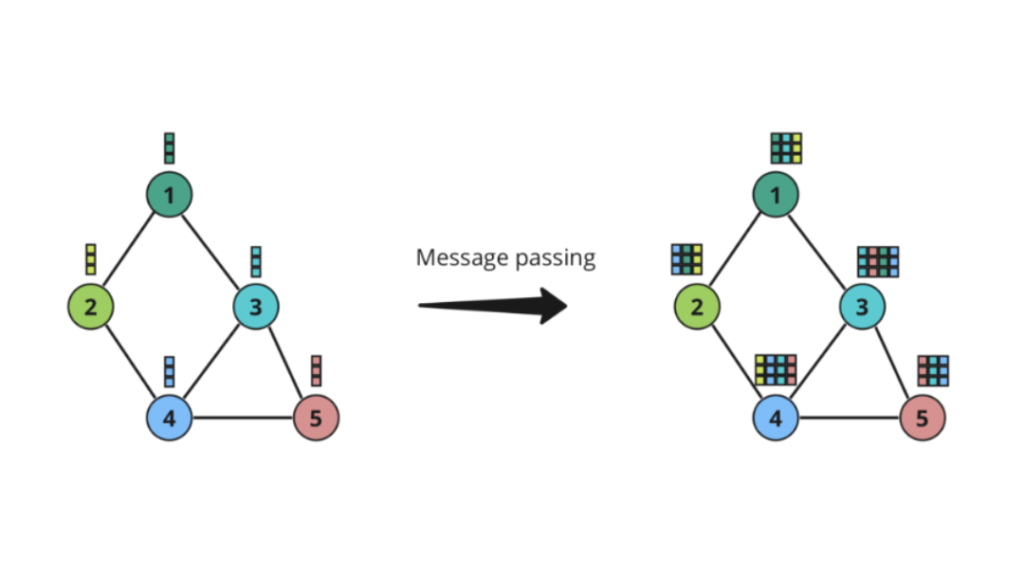
Traditional Graph Neural Networks work using a concept called ‘message-passing‘ where embeddings assigned to each node using either a pre-trained encoding model or through a random algorithm aggregate with embeddings of all of their direct neighbors. This process happens sequentially, starting from the innermost level of nodes and then goes down further.
This also means, as we go deeper into the knowledge graph, the nodes will keep having features and context from an even larger number of nodes due to the sequential nature allowing a passage for noise to come in if not handled properly.
GNNs are also very computationally expensive because they use every single node in the graph. In case a new node ever needs to get added, the whole computation needs to be done again for the embeddings to be generated once more.
GraphSAGE
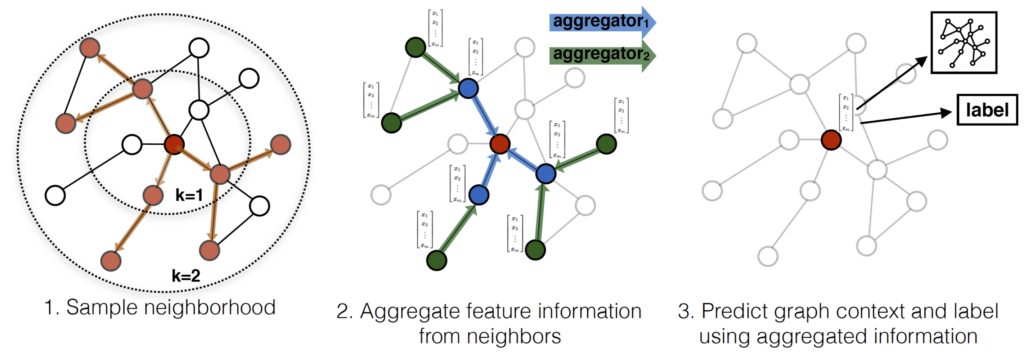
GraphSAGE (Graph Sample and Aggregate) is an improvement over traditional GNNs that addresses the inefficiencies of full-graph computations. Instead of aggregating information from all direct neighbors of a node, GraphSAGE samples a fixed number of neighbors, making the process more scalable. This allows it to generalize well to large graphs and even handle dynamic graphs where new nodes can be introduced without recomputing embeddings for the entire structure.
Another key difference is that GraphSAGE does not store fixed embeddings for each node. Instead, it learns a function that can generate embeddings on the fly based on the sampled neighborhood. This inductive approach makes it especially useful when dealing with unseen nodes, as it can generate meaningful embeddings without retraining the entire network.
By using techniques like mean aggregation, LSTM-based aggregation, or pooling, GraphSAGE ensures that each node can still capture structural and feature-based information from its surroundings while significantly reducing computational complexity. This makes it more practical for real-world applications like recommendation systems, fraud detection, and biological network analysis.
Temporal Graph Networks (TGNs)
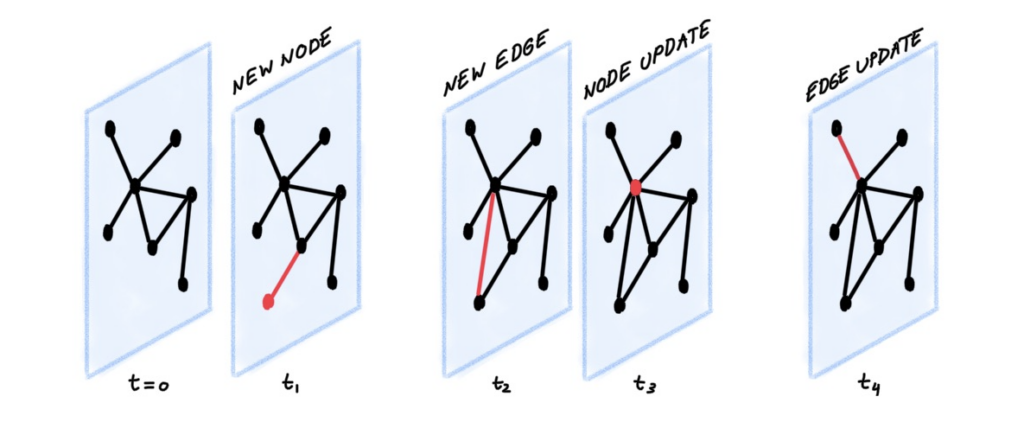
While Graph Neural Networks (GNNs) and GraphSAGE work well for static graphs, many real-world graphs evolve over time. Temporal Graph Networks (TGNs) address this by incorporating timestamps and dynamically updating node embeddings as new interactions occur. This allows them to capture both structural and temporal patterns in evolving data.
A key feature of TGNs is their memory module, which stores historical information about nodes and updates it with each new interaction. This prevents the need for retraining while ensuring that embeddings remain contextually relevant over time. Attention mechanisms and recurrent architectures like LSTMs or transformers help TGNs prioritize recent and meaningful interactions.
By efficiently handling dynamic graphs, TGNs are particularly useful for applications such as fraud detection, social network analysis, and event-driven knowledge graphs. Their ability to process data in real time makes them a powerful alternative to static graph models in rapidly changing environments.
Conclusion
Choosing the right graph model depends on the nature of the data and its application. Traditional GNNs work well for small, static graphs where full message-passing is feasible, but they struggle with scalability. GraphSAGE offers a more efficient alternative by sampling neighbors, making it ideal for large, evolving graphs that require fast and inductive learning. For applications where time plays a crucial role, TGNs provide the best solution by dynamically updating embeddings based on historical interactions. Understanding these differences allows for better decision-making when working with Knowledge Graphs, ensuring both efficiency and accuracy in real-world applications.
Leave a Comment